
 |
 | [中医][组图]快讯|国家中医药管理局 |
| [中医][图文]“简、便、验、廉”! |
| [中医]云南:投入超35亿元支持中医 |
| [中医][图文]从“治未病”到“抗衰 |
| [中医][组图]香飘飘牵手浙江中医药 |
| [中医]2025年度中华中医药学会科学 |
| [中医]中医医保支付将进行改革试点 |
| [中医]广东省长王伟中调研时强调: |


Codonopsis(党参)
|
文章导读: |
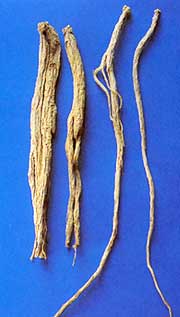
Latin Plant Name :Codonopsis Pilosulae
Pinyin Mandarin Name:Dang Shen
Common English Name:Codonopsis
Part of Plant Used:Root
Nature:Neutral
Taste:Sweet
Meridians Entered:Spleen, Lungs
Common Usages:
This herb is used in formulas to treat fatigue with poor appetite where there is poor internal metabolism (TCM: stimulates function of Spleen and Stomach to normalize movement of fluids; tonifies Spleen and Lungs to metabolize and disperse Qi); also used for chronic diarrhea (TCM: chronic Spleen Qi deficiency); and to treat symptoms of easy bruising and prolapse of Organs and tissues such as uterus and hemorrhoids.
Traditional Usages and Functions:
Tonifies Middle Burner and benefits Qi; tonifies Lungs; strengthens and tonifies Qi and nourishes fluids; builds Blood.
Common Formulas Used In:
Tang Gui and Indigo
Processing Required:
-
Remarks:
Codonopsis is often substituted for ginseng, although it is not as strong. Some practitioners consider codonopsis to be more damp than ginseng, thus requiring more care in use, especially with a serious collapse of Qi and Yang, a condition where ginseng shines as a treatment.
Cautions in Use:None.
|
|
-
没有相关Article














本站点内文章如涉及侵犯版权,请与我们联系。欢迎您为中医人的成长献策!
中医人忠告:站点内之医案、用药仅供参考,任何药物的使用都应咨询医生意见!
版权所有 Copyright© 2005-2018 中医人网络 网站域名:Www.tcmer.com 地址:中国·广州